Published July 23, 2021 10:36AM
Sarah Gigante: Tokyo selection 'a dream come true' for Olympics obsessed Australian
The Australian time trial champion has had to come back from a huge setback to make her dream come true in Tokyo after she broke her collarbone, fibula, and elbow in a crash in April.
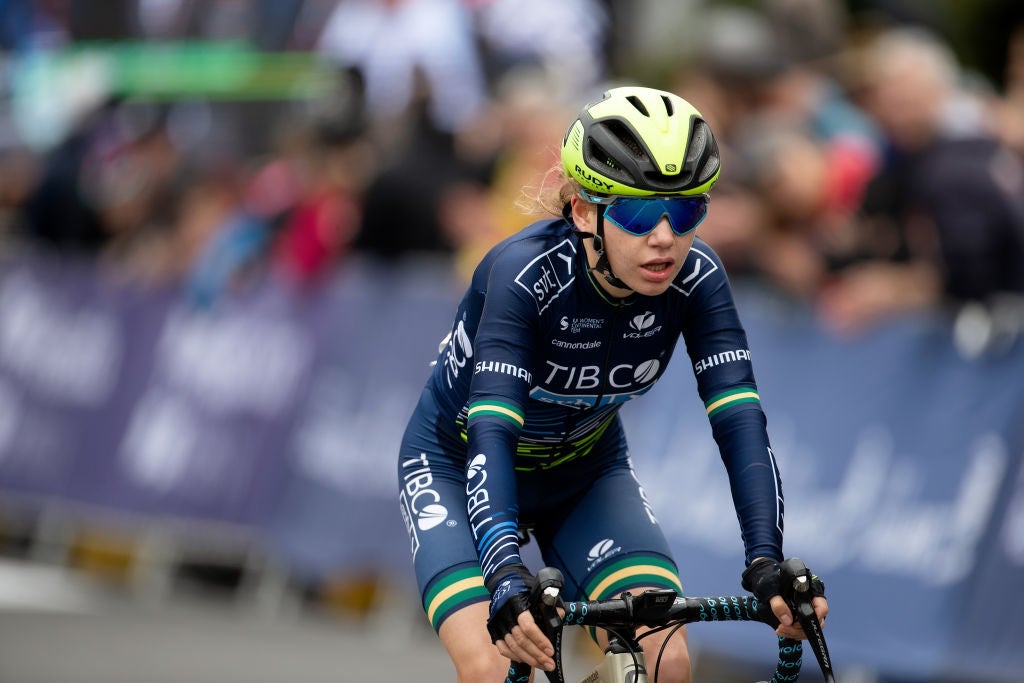
Sarah Gigante has been a rising star in women's cycling (Photo: Brett Keating/Speed Media/Icon Sportswire via Getty Images)
Sarah Gigante wasn’t even allowed to ride her bike outdoors when she got the call from Australia’s Olympic Games selectors.
The 20-year-old still had a week to go on her indoor training sessions as she recovered the broken collarbone, elbow, and fibula she suffered in a crash at Flèche Wallonne when she was told she would be heading to Tokyo.
Being selected for Australia’s four-rider road team was a childhood dream come true for Gigante and it made the last week of indoor training much easier.
Also read: The future is giant for Tibco-Silicon Valley Bank’s Sarah Gigante
“I always loved watching the Olympics. Like not just cycling, but all the sports,” she said. “I was always like, ‘oh, wow, it would be so amazing to go’. But I never really believed I could. I was just obsessed with the Olympics. I remember, I moved house with my mum in 2011 and we never watch much TV, so we didn’t actually bother getting a TV until the London Olympics came around. We got a TV just for that.”
ADVERTISEMENT
Gigante only turned professional last season and readily admits that she would not have been in Tokyo had the Olympics been held in 2020. However, she has been one of the rising stars in the peloton.
The two-time reigning Australian time trial champion, it is the chrono that she is most looking forward to in Tokyo. She just wishes that the 22.1km route was about 10 times longer.
Dealing with homesickness and setbacks
Gigante nearly always has a smile on her face and seems to have a positive outlook on everything, but the last few months have been testing for the young rider. As with many Australian riders, she has to base herself in Europe for the full season and this is the longest she has ever spent away from her home country.
ADVERTISEMENT
“With COVID in particular, I don’t think I would have gone home anyway, but just the fact that I couldn’t go home even if I wanted to seems to make it a little bit harder,” Gigante told VeloNews. “I will say that my mom is a saint and pretty much turned nocturnal and seemed to answer my calls at any time of the day.”
Also read: Three teams that could beat the Dutch in the women’s road race
Getting injured in Belgium so soon into her time in Europe didn’t help with those feelings of homesickness but, thankfully, Gigante had some strong support from her teammate Eri Yonamine and was able to find a little bit of Australia in Girona to help her out.
“The first month was pretty tough,” she said. “Firstly, I had to go around Belgium a bit because the first hospital was a bit dodgy. So I was on the other side of the country, and then I went with my teammate Eri, who lives in the Netherlands.
ADVERTISEMENT
“Then I had to get to Girona and that was pretty challenging. Suddenly Australia seemed really far away when I’m like, trying to walk through the airport. I couldn’t put any weight on my right leg but then I had a really heavy backpack, and I also couldn’t put it on my right shoulder. I was just like, this sucks.
Accepting that she was not where she had been just a few weeks before was just as difficult as the training.
ADVERTISEMENT
“At first, the surgeon said, only 30 minutes at 90 watts, which is super low. It took me way longer than 30 minutes to get my kit on,” Gigante said. “I’ve never had three weeks not training at all for as long as I can remember. It was hard mentally, even that first ride outside. I should have been super happy about finally getting to ride outside in Girona, and I’d been on the ergo for weeks, but I got to the mountain, I did my efforts and then I sat on the side of the mountain calling my coach, pretty upset. I was literally like, this absolutely sucks. It was pretty hard mentally.
“I’ve definitely had to change my mindset, just as a matter of sink or swim. I just kept thinking, oh, my gosh, I’m so slow I’m turning into a sloth. But I’m starting to judge my sessions, more on how well how hard I tried to execute them well, rather than if I really did manage to execute them well.”