Published October 15, 2021 11:02AM
The eight stages of the inaugural Tour de France Femmes avec Zwift
Riders lament the exclusion of a time trial, but otherwise see the route as a perfect challenge with plenty of opportunities for every type of rider.
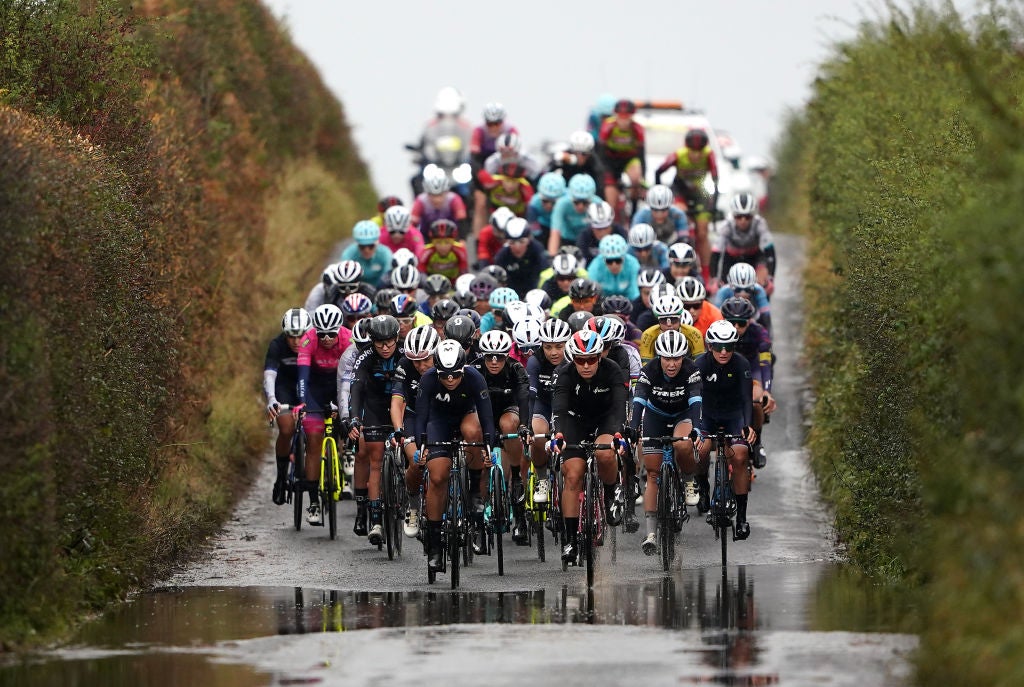
The Women's Tour peloton during stage 2 (Photo: Zac Goodwin/PA Images via Getty Images)
It may be nine months away, but the women’s peloton is already planning for the Tour de France Femmes.
Nevertheless, the 1,029 kilometer race, with its back-to-back mountain stages, multiple days for the sprinters, puncheur-friendly stages, and a little bit of gravel will not lack excitement.
Here, with the help of the pros, we break down each stage.
ADVERTISEMENT
Stage 1: Paris Eiffel Tower to Paris Champs-Élysées, 82km
In many ways, stage 1 is a test for the fans, not the riders. As the women’s peloton gathers in Paris the Sunday after the Tour de France, will cycling fans show up in droves or be sleeping off their hangovers? The first day of racing will be fast and exciting but most importantly, ground-breaking.
Stage 2 is flat, again, but does end with a little excitement on a false-flat climb into Provins.
ADVERTISEMENT
“It begins pretty flat for the first few days, but I am for sure those stages will be really tricky, with everybody wanting to win, help their sprints, and with it being the first few stages of the first edition, everyone will be nervous,” said Urska Zigart of Team BikeExchange.
Stage 3: Reims to Épernay, 133km
Although stage 3’s distance is nearly the same as stage 2, this day will see much more topography. Stage 3 undulates through the Champagne wine-growing region and will give climbers a chance to stretch their legs on five categorized ascents. It’s an uphill into Épernay, and riders will have to dig deep to cross the line after tackling the Côte de Mutigny before the finish.
“That Champagne area can be really fun, punchy-type racing, as well,” said Tiffany Cromwell of Canyon-SRAM.
Stage 4: Troyes to Bar-sur-Aube, 126km
Sorry Annemiek, stage 4 goes off-road. Four times, to be exact. This stage could force a shakeup in the GC as the course ventures into unpaved terrain four times in the last 60 kilometers. Its overall character is punchy with six climbs, so van Vleuten (who dominated the white, gravel roads of the 2020 Strade Bianche) should have nothing to fear.
Not since the 2020 Giro Rosa has the women’s peloton seen a stage of this length; even then, the distance far exceeded the UCI’s recommended distance for women. Will fatigue have set in by the fifth day or will the fifth day create the fatigue?
ADVERTISEMENT
“Also, the fifth stage at 175km long will be interesting as we normally don’t race close to this distance, especially during a stage race,” Deignan commented.
“I’m the first to say I’m not a fan of those stages because it tends to be more negative racing. But it’s good that not every stage is super long or super short, it’s a nice mix of everything,” added Cromwell.
Stage 6: Saint-Dié-des-Vosges to Rosheim, 128km
Amid the praise for the Tour de France Femmes route are numerous lamentations that the eight-day race does not include a time trial. Stage 6 has a flat finish after four categorized climbs, including the six percent Côte de Boersch which could toss riders into an interesting bunch before the finish line.
ADVERTISEMENT
“With the start in Paris, at the same time as the men’s finish, and then seven stages over different terrain, it’s a varied round where different riders get their money’s worth. It would be very nice for the tension in the match if the decisive moment only came at the last. I honestly expected that there would be a time trial. That makes the round complete. But I also think that the tension of the races is perhaps even more beautiful in a stage than in a time trial and that that choice may have been made for that reason,” said Marianne Vos of Jumbo-Visma.
Stage 7: Sélestat to Le Markstein, 127km
Today the real climbing begins. The penultimate stage to Le Markstein includes three categorized climbs ranging from 7km to 13.5km in length. The overall profile of stage 7 includes nearly 3,000 meters of climbing.
It’s only fitting that the women finish the first-ever Tour de France Femmes on a seven-kilometer slog up a mountain. Who needs a ceremonial march into Paris!
ADVERTISEMENT
“That’s obviously the one that I’m most excited for. I think it’s going to keep everyone on the edge of their seats until the last stage,” said SD Worx’s climber Ashleigh Moolman-Pasio.