Published January 13, 2022 08:19AM
The green revolution: The teams going carbon neutral in the fight against climate change
A growing number of teams are addressing their impact on the climate, such as Movistar and Quick-Step, but there is much more to be done.
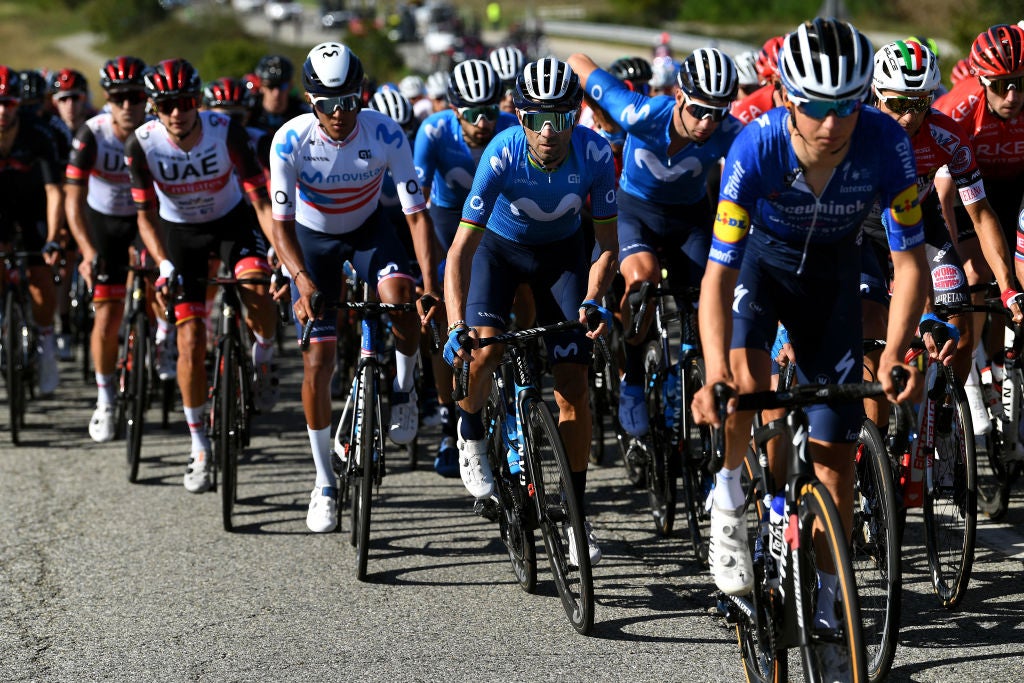
Movistar is one of the teams that has gone carbon neutral (Photo: Tim de Waele / Getty Images)
This is the third article in a series of four on VeloNews on the subject of the environment and sustainability in cycling. Read part one, part two, and part four of the series.
Climate change is forcing us all to think differently, and professional cycling is no different.
As “once in a generation” weather events become far more regular, it is hard to ignore what is happening on our planet. Though there are those that deny the human influence behind it, the overwhelming evidence suggests our own activity has caused climate change.
Professional cycling is a sport steeped in history and tradition, something that can often stymie major progress. Many people have tried and failed to shake up cycling and failed but the green revolution in the sport is one we can’t afford to fail.
As with any progress in cycling, change has been slow on the issue of sustainability, but a growing number of teams are nailing their colors to the mast. At WorldTour level, Quick-Step Alpha Vinyl and Movistar have both committed themselves to going green.
Also read:
- The green revolution: Can the cycling industry become environmentally friendly?
- The green revolution: Can the professional peloton effect change?
Movistar’s efforts, which has seen them put solar panels on their HQ and set up a reforestation project, have been such that the UCI is using it as an example of best practice for others to follow. Team CEO Miguel Grávalos — who joined mid-2020 — has been one of the driving forces behind Movistar’s eco push.
ADVERTISEMENT
Also read: How InstaFund Racing will race around the world on a carbon-neutral budget
Through its reforestation project, the team has already planted 1,000 trees in its local area of Navarra. There is disagreement within the scientific world about how much reforestation schemes can help reduce the amount of carbon in the atmosphere, but they are effective carbon stores.
Over its lifetime, a tree can store on average one ton of carbon.
Movistar is also currently generating 50 percent of the electricity at its HQ using solar panels and is working with supplier Volvo on transitioning its vehicle fleet to hybrid and electric. Meanwhile, it is utilizing carbon offsetting where it can’t eliminate emissions.
ADVERTISEMENT
Not just fireworks
There’s still a long way to go in terms of reducing Movistar’s carbon footprint but Grávalos wants to make sure anything he does is not just talk. He wants the rest of the peloton to follow suit.
“Whatever we do is going to be something real. I don’t want to throw fireworks. There are many things that have been said about sustainability but most of them are no more than fireworks,” he said.
ADVERTISEMENT
Plans are in place to create a resource on the UCI website for cycling stakeholders to assess their impact on the environment, but it won’t be ready until at least later this year.
“Data analysis, benchmarking, and collaboration will help our sport understand the environmental impacts of its operations and value chain to identify solutions and achieve carbon neutrality in the future,” the UCI said in a statement sent to VeloNews.
“The UCI also plans to support cycling stakeholders to start measuring the climate impacts of the sport’s activities through carbon footprinting which is the best tool to understand our climate impact. The UCI is currently working on the objective of providing a carbon calculator for the cycling world in the future to support wider environmental impact measurement and harness the sport’s foundation in data to drive continuous improvement.”
ADVERTISEMENT
Planning ahead
A team making some of the biggest changes in cycling is the Canadian Continental women’s squad InstaFund Racing. In June 2021, it made a pledge to eliminate single-use plastics from the squad and it intends to go carbon neutral in 2022.
The team used last season as a test run for this year and what the team learned is that it’s all in the planning and getting everyone on board is key for success.
ADVERTISEMENT
“We were making notes while going about where it was falling down,” team manager Adam Korbin told VeloNews. “The pro of driving is that it’s not as bad as flying, but the downside of driving is you are stopping at gas stations. Almost anything in a gas station is going to have single-use plastic. Planning was very, very important there.
“The other part is the buy-in from the start of the season. That will be very important on all fronts, whether it’s riders or staff. An example of how this went sideways for us last year is you finish the race and you’re handed a bottle of bubbly water it’s in a plastic bottle. That’s where setting the tone right from the beginning of the season and making sure everybody has what is needed to succeed is important.”
As a Continental team, it has a bit more freedom to design its race program as it is not committed to attending a certain number of events. It has utilized this freedom to design a calendar that cuts down on travel. A well-mapped-out calendar of races in North America has helped.
ADVERTISEMENT
“I’m sure that the calendar could be optimized and done in a better way but it’s not that easy,” Grávalos said. “It’s really challenging you because, in the end, the reality is we have to be really proud of the sport that we are involved in. It is probably one of the top sports in the world. We have to preserve it and keep on being as global as we are right now, or even more, and what we have to do is implement measures in order to be neutral.”
InstaFund has been working with a lot of suppliers and partners to work on ways of being more environmentally friendly. Korbin believes that good change is coming but he thinks that more work needs to be done on the pro racing front and he’s not as optimistic as Grávalos about future progress.
ADVERTISEMENT
“I’m definitely optimistic on the production side and I think that we owe it to the brands to give them a little bit of patience as well because these changes can’t be made overnight for a large brand,” he said. “Where I think a lot more work would be to go in is on the professional racing side of things. That I think is a much more challenging thing to change. I think a big part of that does come back down to financial resources. Changes need to make business sense for people to really pursue them. I don’t know if I’m optimistic that exists enough yet in the racing side of the sport.”