Published March 17, 2022 05:06AM
World champion Elisa Balsamo wants to race a women's Milan-San Remo
The Italian will be racing on home soil again this weekend at Trofeo Alfredo Binda, where she hopes to help Elisa Longo Borghini to defend her title.
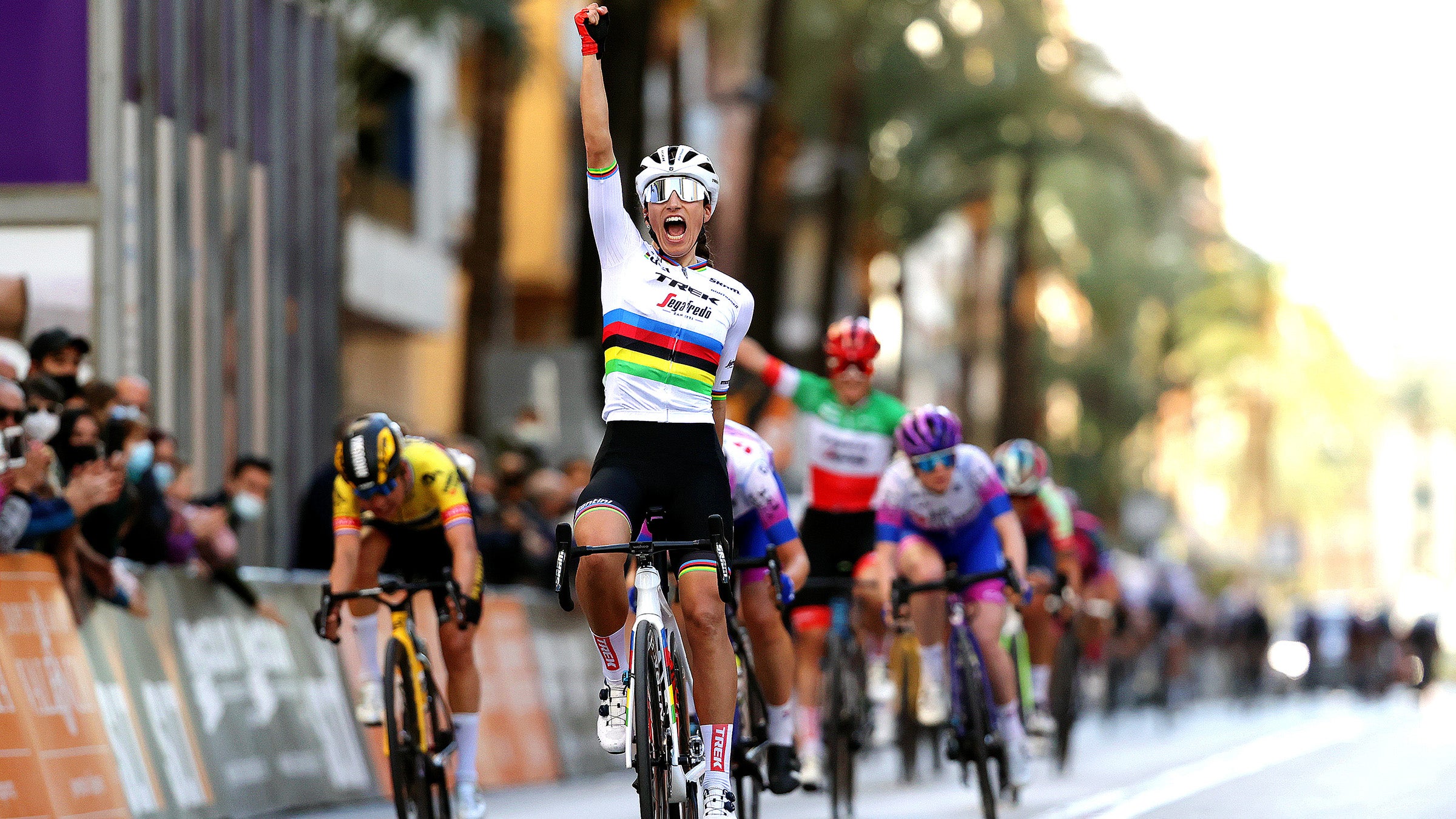
Elisa Balsamo won on her opening race day with Trek-Segafredo (Photo: Gonzalo Arroyo Moreno/Getty Images)
Elisa Balsamo wants to race Milan-San Remo.
This weekend Balsamo’s Trek-Segafredo teammates will set off in the 113th edition of the Italian monument with Jasper Stuyven defending his 2021 title. However, there hasn’t been a women’s version of the event for nearly 20 years.
The Primavera Rosa only ran between 1999 to 2005 before it was canceled by the organizer RCS. With women’s cycling on the up and up and more organizers getting involved, Balsamo would like to see a return of the race to the women’s calendar.
“I really hope that they can have a Milan-San Remo for the women. Of course, is not from Milan to San Remo because that’s very long, but I think that they can do a very wonderful and also exciting race in the last kilometers of the men’s race,” Balsamo told VeloNews.
“It is a hard one, especially with the Cipressa and the Poggio in the last part, but I really hope that I can do one Milan-San Remo for the women.”
ADVERTISEMENT
Also read:
- Bobby & Jens: Elisa Balsamo
- Elisa Balsamo shows off her new rainbow stripes for 2022
- Trofeo Alfredo Binda preview: Elisa Longo Borghini aims for title defense
What would a women’s Milan-San Remo look like? Despite carrying the name, it would be unlikely to start in Milan — as Balsamo points out — due to the distance that would need to be covered.
“I think 165 kilometers is okay for us,” she said. “In the men’s calendar, Milan-San Remo is one of the longest races and so we can also make it the little bit longer, but we don’t need more than 160km, I think. The most exciting part is the last part.”
ADVERTISEMENT
At 165km, it would make it the longest one-day race on the women’s calendar at this time.
It’s not just Milan-San Remo that Balsamo would like to see added to the women’s calendar. She says that up to three big classics should include a women’s race in their portfolios — including San Remo — and she has at least one more in mind.
“We have a very full calendar, but we need also I think about two or three really important classic races that now are not in our calendar, I think maybe two or three because all the others are in so we are waiting,” Balsamo said. “I think also Il Lombardia is an important one in Italy, and then I don’t know maybe another in the rest of the world.”
ADVERTISEMENT
Balsamo may not be racing Milan-San Remo this weekend, but she will be competing in her native Italy, at the Trofeo Alfredo Binda in support of teammate Elisa Longo Borghini. The one-day race in Cittiglio is, like San Remo, an often-unpredictable contest where the winner can just as easily be decided from a reduced bunch sprint as it can be from a breakaway.
Making gains in women’s cycling
There have already been plenty of new races added to the calendar in recent years, with one of the most recent additions a Tour de France Femmes. Balsamo will be racing at the Tour with the intention of helping Longo Borghini to overall victory.
ADVERTISEMENT
Before that, she will also be making her debut at her home grand tour of the Giro d’Italia Donne. After some years of struggle and a demotion out of the WorldTour last year, the Giro d’Italia has stepped up its game for this season with five times the prize money available and a boost in TV coverage.
Whether or not it all works out as planned remains to be seen but Balsamo is very pleased about the improvements. She also believes that the Giro and the Tour can benefit each other.
Balsamo doesn’t think that is a bad thing and says it allows riders to diversify their racing programs.
ADVERTISEMENT
“I think that now we are a lot of girls. So it’s okay that we have double activities and a one can race every week,” Balsamo told VeloNews.
“It’s also good, because we can choose which races are the best for our preparation and for us, and so all of the girls don’t have to choose only one way, but we can follow a different way for our season.”
While she is just 24 years old, Balsamo is already a stalwart of the women’s peloton after turning professional in 2017 following her junior road race world title the year before. Over the last five seasons, she’s seen women’s cycling change dramatically and she is looking forward to seeing where it can go over the course of her career.
ADVERTISEMENT
“I think that women’s cycling is on the right way of improving. For me, one of the most important thing is the TV coverage,” she said. “If we can have, maybe not all the race, but a lot of hours on TV, we can improve a lot because sponsors can come because they can have a lot of visibility and also the teams can make more steps in women’s cycling.
“I think that our races are not so long and so watching them is very exciting. Maybe there is not a breakaway with a lot of minutes, but the race is more open and with a lot of suspense and the solution.”