Published July 17, 2023 10:48AM
Explainer: Can the Netflix documentary 'Unchained' grow cycling in the US?
Former pro cyclists weigh in for part four of this series.
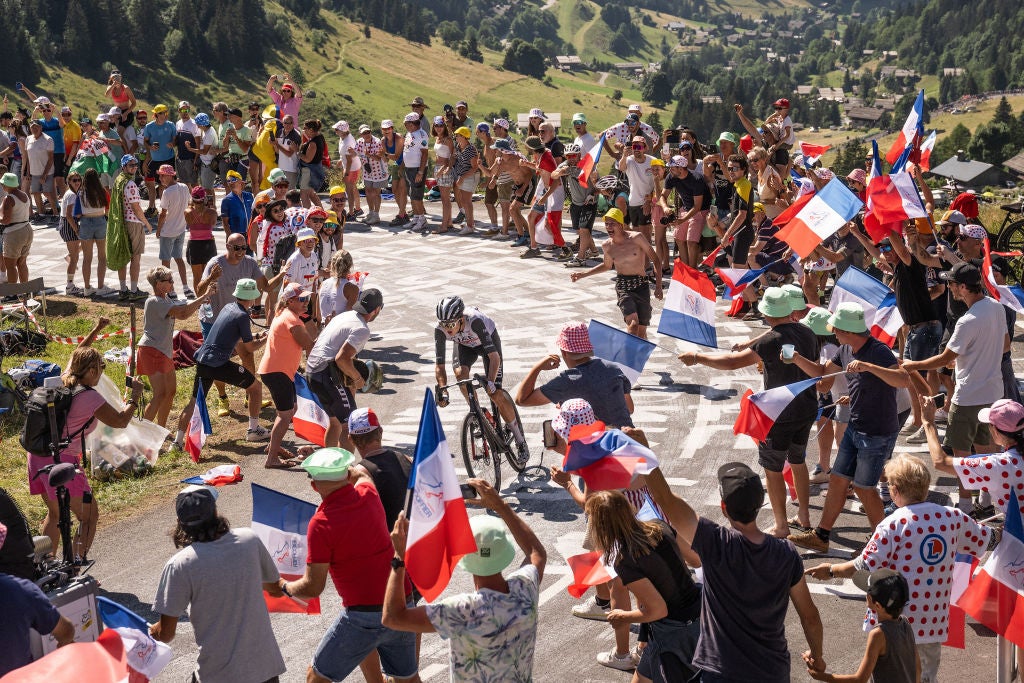
SAINT-GERVAIS MONT-BLANC, FRANCE - JULY 16: Marc Soler of Spain and UAE Team Emirates competes in the breakaway climbing to the Col des Aravis (1483m) while fans cheer during the stage fifteen of the 110th Tour de France 2023 a 179km stage from Les Gets les Portes du Soleil to Saint-Gervais Mont-Blanc 1379m / #UCIWT / on July 16, 2023 in Saint-Gervais Mont-Blanc, France. (Photo by David Ramos/Getty Images) (Photo: David Ramos/Getty Images)
The Tour de France is one of sport’s greatest spectacles, a three-week extravaganza boasting some of the biggest audiences of any sporting event in the world. But how can we boost its popularity and attract more fans in the United States? In this issue, Steve Maxwell of The Outer Line digs further into the issue of exposure, and discusses the recent Netflix “Unchained” series with a number of former star riders and team managers.
Last time, we talked about the need to make bike racing more accessible and to increase the general public’s exposure to the sport – to ensure, as Bobby Julich put it, that “bike racing is a thing.”
One major development in this regard was the recent and highly anticipated release of the Netflix series “Unchained.” This eight-part series followed the 2022 Tour de France, and was produced by the same group that created the blockbuster “Drive to Survive” series about Formula One racing. That series, now in its fifth season, is credited with greatly boosting viewership of the sport, and revolutionizing American interest in F1.
Also read
- Boosting the Tour’s popularity in the U.S., part 1
- Boosting the Tour’s popularity in the U.S., part 2
- Boosting the Tour’s popularity in the U.S., part 3
Netflix also produced similar series last year that delved into both professional tennis and golf – both of which were also critically acclaimed. Hence, there was a great deal of excitement and anticipation around the cycling world, when it was announced over a year ago that the same group would be producing a series on pro bike racing.
ADVERTISEMENT
“Unchained” was released in early June, and immediately created a new cottage industry in the cycling world – as everybody fell over each other trying to appraise and critique the series. Scores of cycling media platforms and blogs felt obliged to weigh in with their own take on the series, how it might impact viewership, and what it could do for the future of the sport. There was even a podcast reviewing each individual episode of the show. “Unchained” definitely qualified as one of the big events of the year in pro cycling.
And, as might be expected, the reaction from the cycling community was mixed. Some harder core racing devotees found it too simplistic, or pooh-poohed its often elementary description of what can be a very complex and nuanced sport. But, as others pointed out, the series was not really intended to cater to longtime or hard-core fans; it was geared at a level to attract casual or completely new fans to the sport.
“I feel like the popularity of cycling as a pastime or fitness activity has never been greater in this country,” says Christian Vande Velde, “especially over the last few years with the impact of COVID helping to build outdoor activity.” But so far that greater interest in cycling doesn’t seem to be translating into more interest in bike racing. “This new Netflix series should give us a bump in the right direction – I think it got a surprisingly positive review. I watched it with my 16-year-old daughter and she was like “Wow, this is so cool! Is this what you used to do, Dad?”
ADVERTISEMENT
George Hincapie echoes the comments of many folks around the cycling industry. “I thought it started out a bit slow, but it got better as it went, and it really sucked me in. I’ve talked to a lot of casual fans who really liked it, and who learned a lot about cycling. I think my son, who is becoming a serious cyclist, learned something from it. And even my daughter enjoyed it – she told me she learned that there is teamwork in cycling. She’s the daughter of a pro cyclist – and this TV show is how she learned that there’s teamwork in cycling!”
Davis Phinney says, “This show should be must-see TV for anyone who wants to gain a better appreciation for bike racing, and greater insight into the riders involved at the Tour.”
He says that the show reminded him of the old CBS TV productions that aired on Sunday afternoons during the Tour in the 1980s – produced by David Michaels, and narrated by John Tesh and Phil Liggett. “Those were exceptional shows, portraying the drama of the race to a greater degree than a daily show could do. Why? Because, just as with “Unchained,” there were more cameras and more time to put the shows together, and that made for richer content.”
ADVERTISEMENT
Informal surveys of family, friends and casual bystanders seem to suggest that the series has been well-received by the broader public. The narratives about individual athletes – their personal story … family, wives, children, personal quirks and foibles – are what tends to pull in new fans, fans that otherwise wouldn’t necessarily be attracted to the sport. “Drive to Survive” certainly achieved this, zeroing in on a number of the most interesting characters in Formula One, making them more visible to the world, and hence driving greater interest in the sport. Once you get interested in the individual athlete, you’ll be more interested in watching to see how he does in his next race or game.
Says EF Education-EasyPost boss Jonathan Vaughters, “Maybe a lot of core fans didn’t love the Netflix series, mostly because it focused on personal stories. But those human interest stories are more interesting to most people than the racing itself. Of course, that’s both good and bad.”
Nonetheless, one critique of “Unchained” was that it did not dig into cycling’s interesting or controversial personalities as well as it could have, or as deeply as its other sports series have done. Cycling has its characters, just like any other sport, but they didn’t come through as strongly in this series. In addition, only seven out of the 18 WorldTour teams participated in the series, leaving out such star riders, and potential public ambassadors, as Tadej Pogačar – surely one of the most colorful and interesting riders in the peloton.
ADVERTISEMENT
Alex Stieda says, “I just had the feeling that the Netflix series was really more about the race, and about ASO – not about the riders – whereas people are interested in learning more about the personalities in the sport.” Several other observers pointed out that the series has a rather French-centric feel to it – having been supported by the Tour organizer ASO and French TV, and with an original soundtrack in French.
The Netflix series had the good fortune of focusing a good bit of its first season on Team Jumbo Visma, even though at the outset they could not have known that the still relatively unheralded Jonas Vingegaard would end up winning the Tour. It was a fortuitous choice from the perspective of the producers, as they closely followed Vingegaard and his teammates throughout. But there were still a lot of interesting riders who did not feature at all in the series.
Andy Hampsten, one of America’s greatest riders, winning the 1988 Giro as well as a stage in the Tour atop the Alpe d’Huez in 1992, underlines that importance of having a key personality to follow.
ADVERTISEMENT
“I think many people like to have a winner to relate to, and at the moment Vingegaard is filling that role for a lot people, particularly the Danish audience, especially since he has already won one Tour. He seems to be an interesting person and one who is fun to follow. But he is not American, and so is his story is probably less interesting to most U.S. viewers.”
There have been other, fairly widely-distributed, streaming series about cycling over the last couple of years, including films about both individual teams and individual events. The Team Movistar – “The Least Expected Day” – covered the team’s racing seasons for 2019 through 2021 and received generally good reviews, but didn’t seem to cause any notable increase in viewership.
The sense of most observers seems to be that “Unchained” will help, but that it won’t cause any major shift or transformation in terms of Americans’ viewing habits. For that, “we really need another Armstrong,” says Jim Ochowicz – a dominant and podium-worthy American who can capture the imagination of the country. (We’ll discuss the likelihood of that in a future article.)
ADVERTISEMENT
Meanwhile, the real Lance Armstrong says, “I’ve heard the series was pretty good, and hopefully it’ll help – but cycling needs to be realistic. Just because F1 had ‘Drive to Survive’ and doubled their viewership doesn’t necessarily mean that we’re going to; they’re two very different sports.”
Viewership figures are one thing that we can measure, and within a few days after the Tour wraps up, we should have a good idea of whether and how much “Unchained” actually impacted the size of the U.S. audience this year.
Steve Maxwell is one of the founders and original investors in Outside. He has written extensively for VeloNews over the years, and is a co-editor of The Outer Line, which focuses on governance and business issues, contrasting pro cycling with other sports. Subscribe to The Outer Line’s weekly AIRmail newsletter here.