Updated February 10, 2026 03:36AM
Training Camp from Hell: What Happens When a Pro Team Gets Snowed in at Altitude
The grim reality of 6-hour Zwift sessions, 'bike skills drills,' and some very dubious meals emerge from a frozen Uno-X camp on Sierra Nevada.
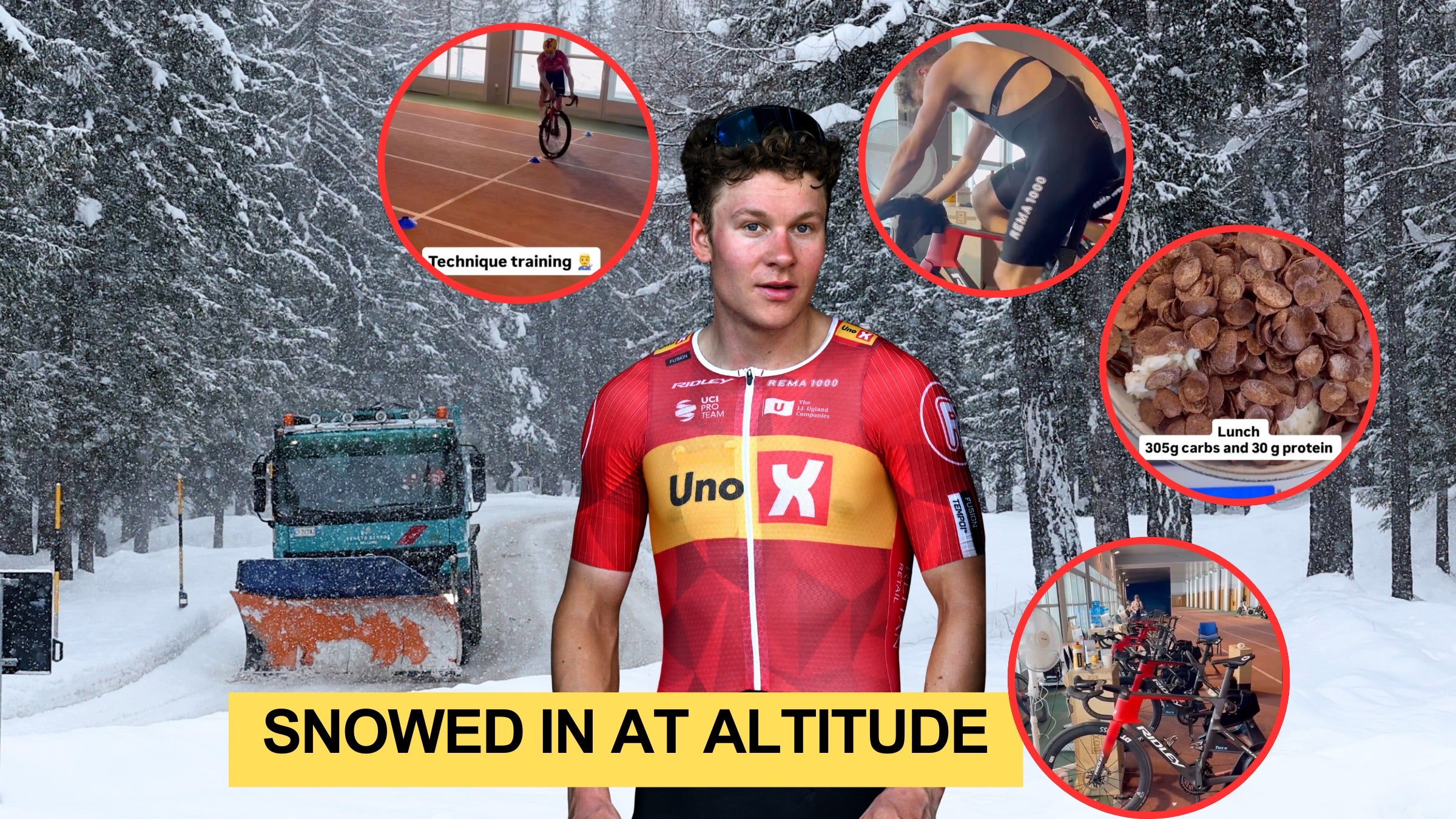
(Photo: Getty Images + Abrahamsen Instagram)
Come to Sierra Nevada, they said. It will be warm, dry, and sunny, they said.
Jonas Abrahamsen and his Uno-X Mobility teammates were sold a training camp dream that turned into a whiteout.
The Uno-X crew has been sucking thin air on top of Sierra Nevada for the past three weeks, and it’s safe to say the weather has not been kind.
The region has been hit by arctic blasts that must have made its Scandinavian guests feel right at home. Local weather alerts detailed high winds, heavy rainfall, and a drop in the snowline to 1,200m.
Worse still, Sierra Nevada’s plowing teams evidently didn’t see a bunch of cyclists stuck at 2,350m as a top priority.
Uno-X has been peering out of hotel windows at tarmac blanketed by 5 feet of snow, and it’s been all but impossible to get off the mountain to train.
But there’s no such thing as a “snow day” on training camp.
ADVERTISEMENT
The local gymnasium has become a high-altitude Zwift center.
Riders have been wearing their chamois ragged as they toil through six-hour indoor sessions that replicate the work that should have been done outdoors.
Snow stops the show for multiple teams on training camp
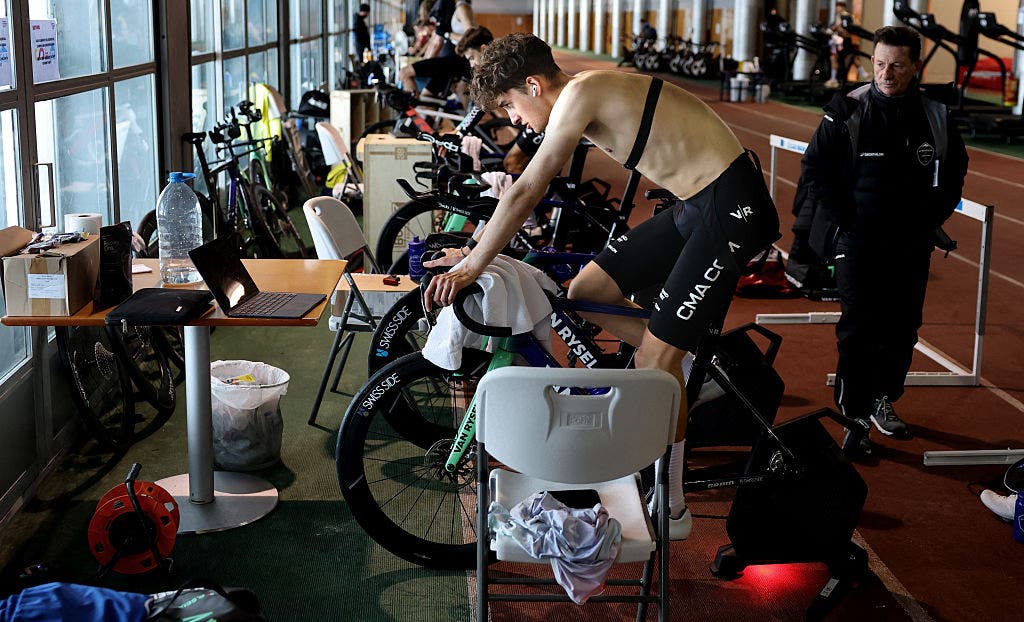
According to Abrahamsen’s Strava, he and his teammates have suffered more than 50 hours of Zwift during their snow-heavy, oxygen-light training camp. They’ve put tires on the tarmac just seven days in 25.
Even for a notorious Zwift fiend like Abrahamsen, that’s a test of mental resilience as much as aerobic capacity.
Decathlon-CMA CGM and Visma-Lease a Bike also parachuted into Sierra Nevada in recent weeks and reluctantly joined the indoor trainer party. Wout van Aert has ridden outside only once in his four days at thin air.
Tom Pidcock and his Q36.5 teammates must have been laughing from their sunloungers while they lazed in the sun of their high-altitude hotel in Chile.
Abrahamsen revealed the monotonous, mind-numbing reality of a snowed-in altitude camp last week in an Instagram reel. Visma’s young star Niklas Behrens posted his own “life in a day on Sierra Nevada” to Instagram a few days later.
Abrahamsen’s video provides a rare insight into the grind of life at thin air, whether a team is locked down or not.
ADVERTISEMENT
The burly classics and breakaway star lifts the lid on 9,000-calorie menus, heinous indoor training sessions, some wacky “technique drills,” and a whole lot more.
ADVERTISEMENT
‘A day in the life’ of an indoor training camp
Breakfast:
500g oatmeal with jam, 2 x bread, omelette: 225g carbohydrate / 900 calories minimum.
This is about as generic a cycling breakfast as you can get. But it works.
Mobility and activation drills:
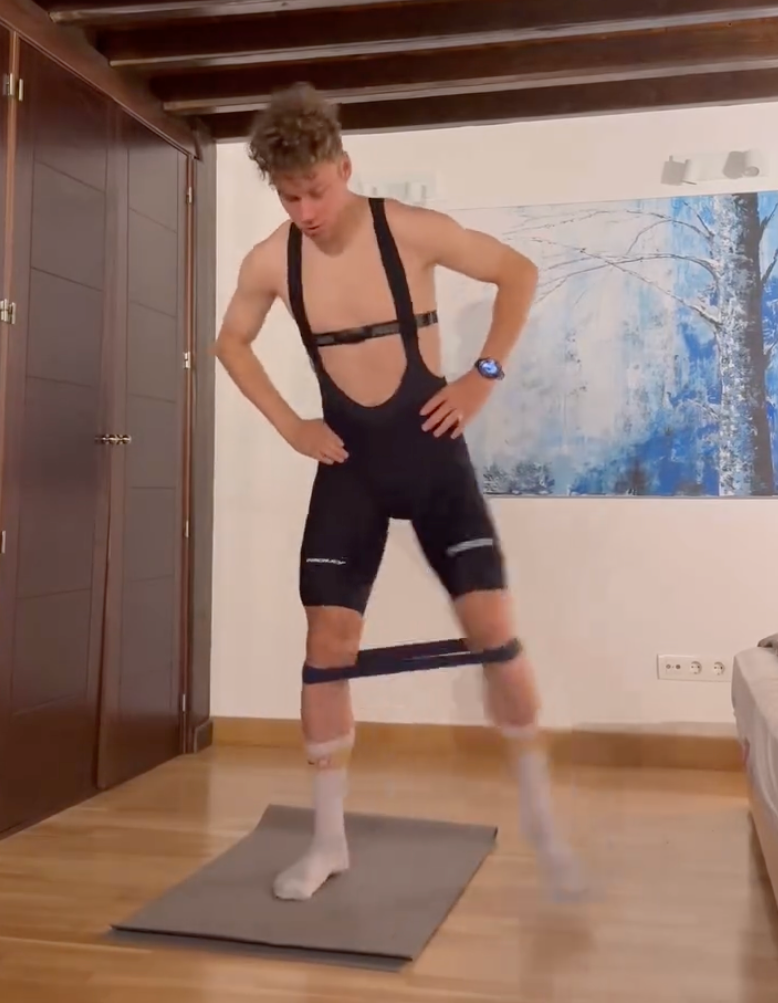
UAE Emirates-XRG sparked intrigue when it shared reels of Tadej Pogačar waddling around before a race with heavy resistance bands around his knees.
But as Abrahamsen shows, these “activation” routines are far from unique. Athletes have been using such drills for years to keep key muscle groups “firing,” and to prevent imbalances or injury.
Abrahamsen also works through a series of basic mobility moves in his 20-minute session.
These workouts are designed to keep riders loose and limber while they spend 30 hours a week hunched over a bike. The spine, hips, and shoulders are typical focus areas that become even more important for a cyclist stuck rigid in Watopia for hours a day.
ADVERTISEMENT
Technique training:
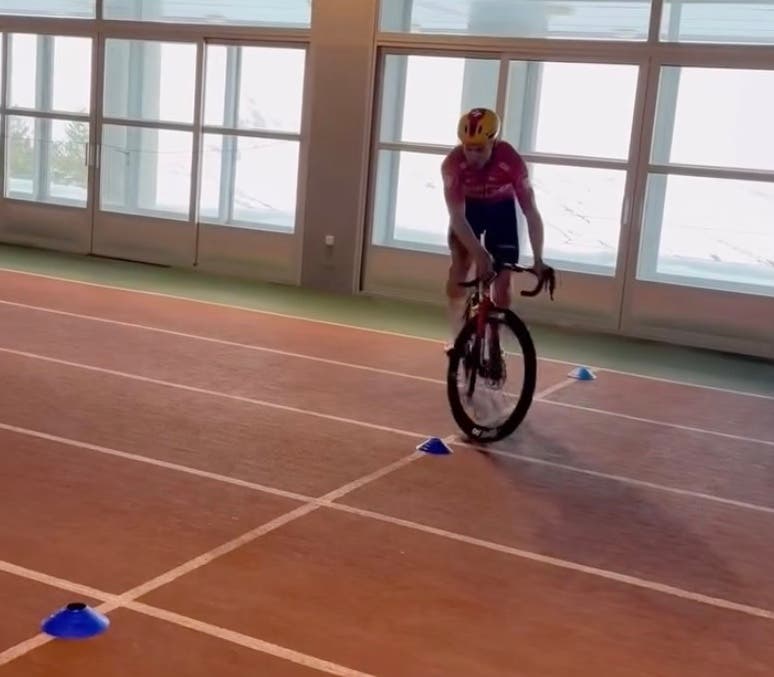
Seeing riders slaloming around cones in a fusty old gymnasium is one of the most intriguing elements of Abrahamsen’s reel. It’s almost unprecedented to see a pro team working on these types of “handling drills.”
Nonetheless, Uno-X’s skills session would do João Almeida proud. UAE’s Portuguese star recently suggested “proficiency tests” would help riders sharpen up for the sensory assault that is a 60kph peloton.
It’s unknown whether Uno-X riders follow these routines when they can also ride outdoors. However, it is likely they would actively practice more race-specific scenarios like leadouts and hand-ups from the team car.
ADVERTISEMENT
Zwift ride 1 (AM):
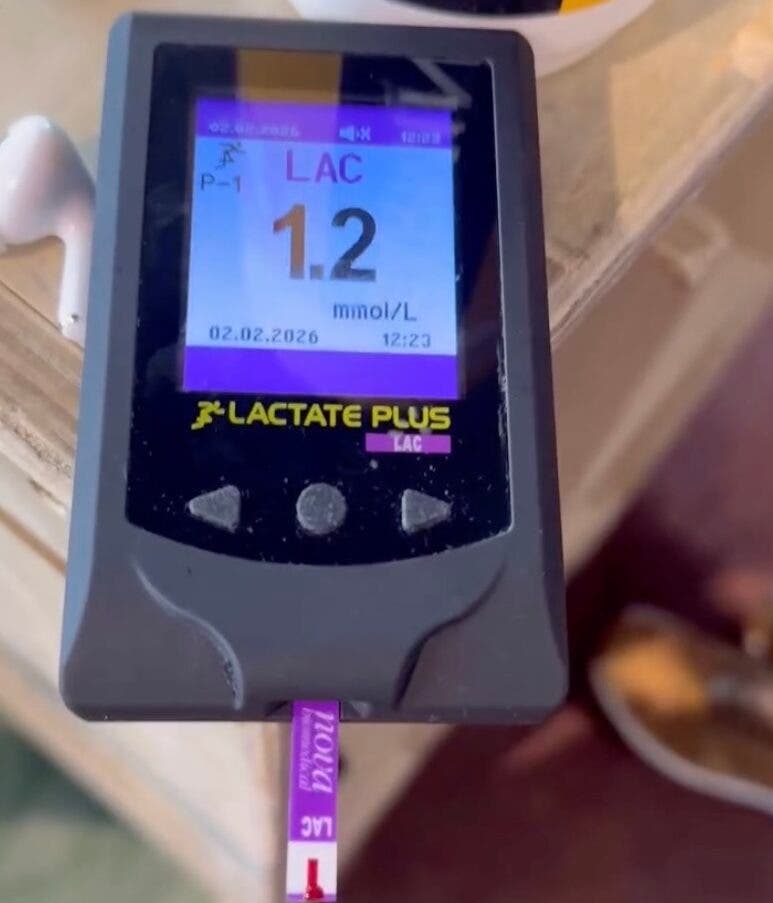
3 hours including 5 x 20 minutes at LT1.
This is a bread, butter, and boring “base ride.” LT1, or the aerobic threshold, approximates to training zone 2.
ADVERTISEMENT
Uno-X Mobility’s head coach Olav Aleksander Bu famously pioneered the lactate-driven “Norwegian method” while he mentored leading triathletes and VO2 Max monsters Kristian Blummenfelt and Gustav Iden.
Many pro cyclists now also use lactate monitors to regulate the physiological toll of training, particularly when heart rates and power zones are affected by altitude.
Recovery snack:
Juice, gummy bears, and presumably a protein / recovery shake: 120g carbohydrate + 25g protein: 580 calories minimum.
Life at the WorldTour isn’t all fancy sport nutrition and chef-produced snacks. Haribos and soda are cheap, tasty, and provide all the quick glycogen a rider needs after three hours on an indoor trainer.
ADVERTISEMENT
Lunch:

Rice with chocolate cereal and maple syrup: 305g carbohydrate + 30g protein: 1,340 calories minimum.
This is the meal of either a madman or a genius. It could be gross or actually quite nice.
Either way, 300g [1,200 calories] of carbohydrate in one meal is borderline crazy. Some “normal” people might not eat that many carbs in a day.
But context is key here. This meal is “fuel,” not food.
ADVERTISEMENT
Abrahamsen needs buckets of carbs to recover from the morning session and reload for another big workout in the afternoon.
The looming presence of a second ride on Abrahamsen’s schedule is also why he doesn’t seem to eat any fat or fiber at lunchtime. Remember, there are no portaloos in Zwift.
Zwift ride 2 (PM):
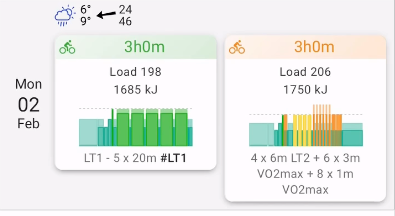
3 hours including 4 x 6 min at LT2, 6 x 3 min at VO2 Max, 8 x 1 min at VO2 Max.
There are three more butt-numbing hours on the indoor trainer for Abrahamsen in the afternoon, and more lactate-guided intervals.
But this time, there’s a lot more effort.
This session combines efforts at LT2 [anaerobic threshold / around zone 4] with a series of lung-busting VO2 Max finishers. It’s a race simulation that builds Abrahamsen’s durability and primes his engine to go deep in the most foul finales of Flanders.
With three hours already in the legs from the morning, this will hurt.
ADVERTISEMENT
Dinner:
Beefburger + 2 x hasselback potatoes: Macro breakdown undisclosed.
This is another good reminder that WorldTour menus aren’t all chicken breasts and white rice [and cereal, in Abrahamsen’s case]. Team chefs often serve burgers, pizza, and other mojo-boosting meals the evening before a rest day.
ADVERTISEMENT
And let’s face it, if a rider is ever in need of a treat, it’s one who just spent six hours staring at his avatar on Zwift.
Daily totals:
- Total training: 6hr 35min / 6,050kJ
- Total calorie burn: 9,200 calories
- Total carbs consumed: 1,800g / 7,200 calories
Uno-X’s high altitude experiment
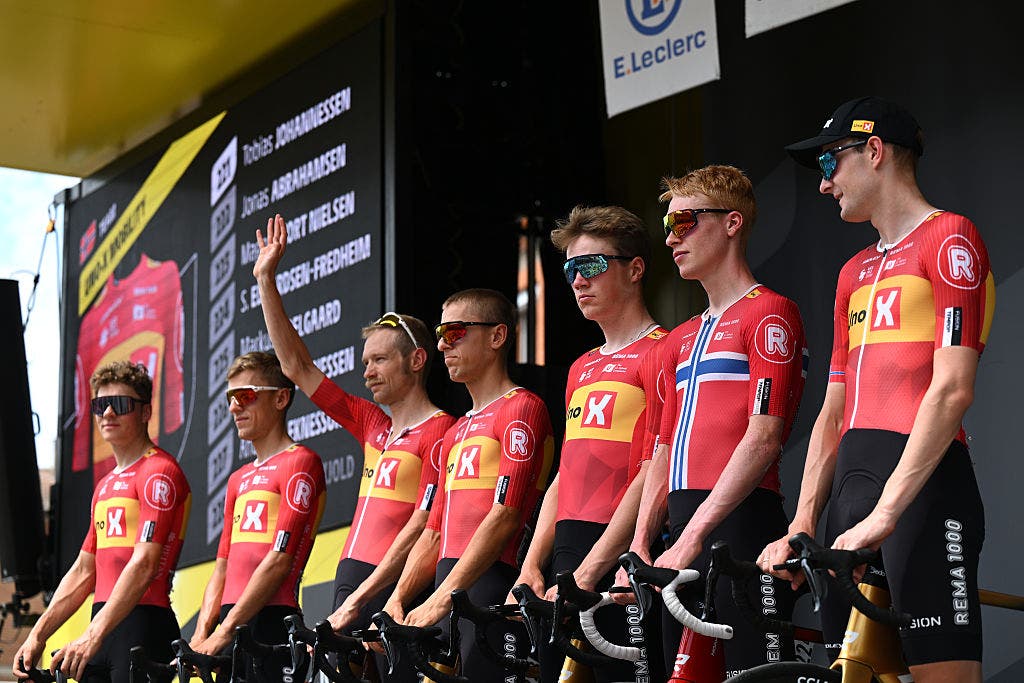
Uno-X Mobility landed in Sierra Nevada for training camp on January 14. That’s the earliest a team has taken to thin air in Europe this year.
For context, Van Aert and a selection of his Visma teammates didn’t arrive until last week.
And the ongoing camp isn’t Uno-X’s first rodeo either – Abrahamsen and multiple teammates were also in Gran Canaria in December.
The team’s new devotion to altitude raised many eyebrows in the WorldTour training community.
But it seems typical of the revolutionary thinking of the team’s “mad-professor” training guru, Bu. It’s been proven that athletes build a “hypoxic memory” over repeated trips to altitude. This increases the efficiency and effectiveness of these high-cost operations by reducing the time riders need to acclimate and prolonging the resulting gains.
But as Uno-X found out in the last month, starting altitude training so early can backfire. There’s no guarantee the weather will play ball in January in Europe.
ADVERTISEMENT
But still, 50 hours on Zwift at 2,350m altitude sure won’t slow down Uno-X Mobility in its debut WorldTour season.